Learn how to make simple changes to your diet and lifestyle and transform the way your body works at a Cooking for Health course on Sunday 23 September 2012 in Somerset UK.
Sunday, August 12, 2012

Tuesday, July 31, 2012
Quinoa, chickpea (garbanzo), avocado and olive salad


Quinoa (pronounced KEEN-wah) is gaining popularity in European cuisine. It is no longer confined to the shelves of health food stores and can also be found in most mainstream supermarkets. The United Nations has declared 2013 the International Year of Quinoa to highlight the virtues of this "golden grain of the Incas".
Quinoa is the seed of a broad leaf plant of Andean origin which is botanically related to the common broad leaf weed fat hen (UK) or lamb's quarters (US), and is often used like a grain. It has a mild nutty flavour and is easy to cook.
Quinoa is as versatile as rice but it has a protein content that is superior to that of most grains, because it contains all the essential amino acids. In particular, quinoa is high in lysine, an amino acid important for tissue growth and repair. It is also a good source of manganese, magnesium and phosphorus.
Not only this, but the crop has a remarkable adaptability to different agro-ecological regions. It can grow at relative humidity from 40% to 88%, and withstands temperatures from -4 ° C to 38 ° C. It is a highly water efficient plant, is tolerant and resistant to lack of soil moisture, and produces acceptable yields with rainfall of 100 to 200 mm (FAO). Whilst Peru, Bolivia and the USA are the main producers, it is currently being successfully cultivated in several countries in Europe and Asia.
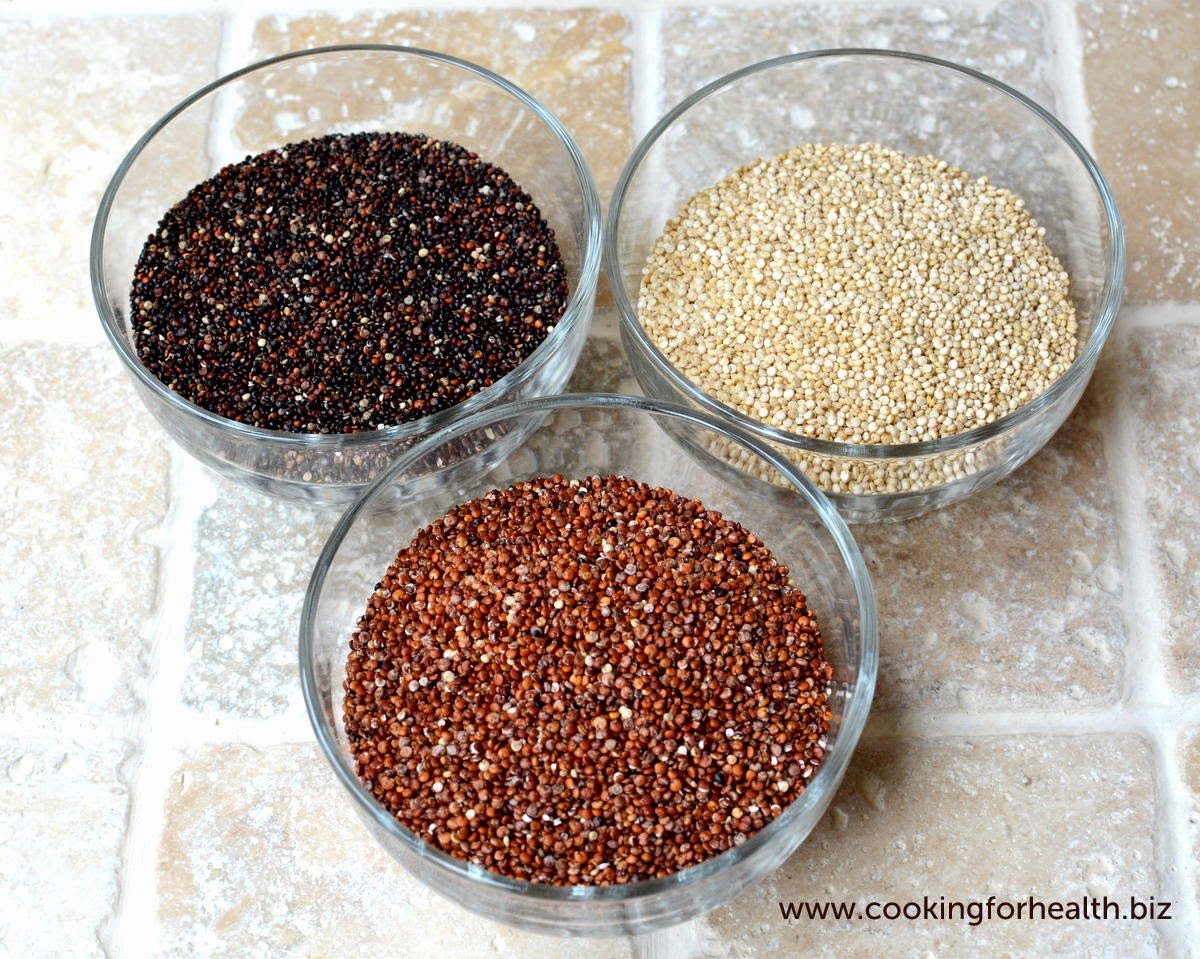
There are more than three thousand varieties of quinoa, grouped into five main classes according to the altitude at which they can grow, The different varieties produce seed of different colours.
 |
| Varieties of quinoa (www.fao.org) |

Cooking quinoa
One of the beauties of quinoa is that it only takes 15 minutes to cook, so you can use it to prepare a nutritious meal in a hurry.
Measure 1 cup quinoa, wash it, drain it and place it in a pot with 1 1/2 cups water. Put on the lid and cook on a medium flame until it boils, then reduce to a minimum flame and simmer for 15 minutes or until all the water has gone. Do not remove the lid during cooking. It is easy to tell when it is done because the seeds display a little white thread that curls around them.
When the quinoa has cooked, you can then mix in your choice of salad ingredients.
Recipe
- 1 cup red quinoa (rinsed in cold water)
- 1.5 cups hot water
- I can chickpeas (garbanzo beans), marinated in dressing (see ingredients below)
- 1 avocado (peeled, chopped and sprinkled with fresh lime juice to prevent browning)
- 12 olives (green, black or mixed)
- 1/2 red bell pepper (washed, de-seeded and chopped)
- 1/2 yellow bell pepper (washed de-seeded and chopped)
- 1 handful fresh basil (washed and finely chopped)
- Fresh basil to garnish
Dressing
Juice of 1 lime
1 clove garlic - pressed
1 teaspoon fresh ginger juice (grate 1 cm piece root ginger and squeeze juice out. For more details please click here)
1 tsp soy sauce
1/4 tsp sesame oil
1. Combine ingredients for dressing and marinade chickpeas in it while quinoa is cooking
2. Add water to quinoa in a thick-based pan. Cover and bring to boil. Turn heat down low and simmer for 15 minutes until quinoa is cooked and water has evaporated.
3. When quinoa has cooled, mix in all other ingredients and garnish with fresh basil.
Serve as a one-dish meal for lunch or as a side dish as part of dinner.
+and+avocado+salad+close-up-001.jpg)
Other ideas for salad ingredients include cherry tomatoes; carrots; spring onions (scallions); other fresh herbs like parsley, coriander (cilantro), lemon balm, oregano, marjoram; cashew nuts; and beans.

If you have enjoyed this post and would like recipes, videos and interesting information delivered directly to your inbox, please click here.
Sunday, September 6, 2009
When is the ideal time to eat?

“Breakfast like a king, lunch like a prince and dinner like a pauper” says the old proverb.
In reality, many people leading busy lives do exactly the opposite. But when is the ideal time to eat?
In ancient times, the Chinese observed that the body’s organs have peak activity at different times of the day and night. They also suggested that an organ’s minimum activity is 12 hours away from its peak activity.
For example, the peak activity of the stomach is from 7 am to 9 am, and its minimum activity from 7 pm to 9 pm.
According to ancient wisdom, the further away from peak liver activity the meal is taken, the more completely the liver can perform its myriad functions.
If the last meal is eaten at 6 pm, seven hours are available for the food to go through preliminary digestive processes.
Since grains and legumes stay in the stomach for up to three hours, that only leaves three hours for assimilation in the small intestine; the products of assimilation must then be processed by the liver.

Thus, many Far Eastern spiritual practitioners eat one meal a day before noon. In this way, there will be at least 12 hours before the liver has its greatest activity.
One meal per day
Serious Zen monks maintain a single meal per day dietary practice.
They are sufficiently energized by this and their other practices, that their only ‘sleep’ is from midnight until 3 am, during which time they sit in meditation.
Three am is the beginning of the lungs’ two-hour cycle and they consider this to be the ideal time to arise and do breathing exercises.
Many yogis and meditators will naturally rise between 3 am and 5 am, a time when qi and breath vitality is heightened.

Because the body is not burdened by digestion, the eight hour period between 3 am and the single meal at 11 am can be a time of profound spiritual experience.
For most of us, such a lifestyle is not a practical proposition.
Unless the individual is highly disciplined there is a temptation to eat three meal’s worth of food at one time, which may create more problems than it solves.
The one meal per day dietary plan does, however, illustrate two key ideas.
One that eating late at night can cause the liver and its subtle metabolic processes to work less efficiently; and two, that with less food one generally has more energy, greater clarity and a lower need for sleep.
Two meals per day
A two-meal per day schedule is optimum for people who have adjusted to a grain and vegetable diet.
In the morning, there should be one to two hours between rising and eating so that the body and internal organs can adapt from a resting to an active state.
It is best to wait until hungry before eating. Often, hunger will not occur until several hours into the morning.
According to the biological rhythms described by the Chinese clock, the hours between 7 am and 9 am are the optimal time to eat, as they are the most active time for the stomach, although 9 am to 11 am, when pancreatic activity is emphasized, is also a good time.
This meal must be moist enough to help with morning dehydration, and must have sufficient calories, protein and carbohydrates to support you through the most active part of the day.

The first meal should be larger than the second and should be prepared with more water.
The second meal may be eaten in the mid-afternoon or later, preferably at about 3 or 4 pm and certainly before sunset or 7 pm, whichever comes first.
In ancient China, sunset was seen as heralding more internal metabolic and hormonal processes.
In addition, according to the Chinese clock, at 7 pm the stomach begins its period of weakest activity. As the second meal is moved later in the day to accommodate work, the quantity should become less. When later meals are eaten, it is best to stay up for at least 4 hours afterwards.
Three meals per day
Eating three meals per day is probably the most practical option for the majority of people.
When you have been raised on three meals per day, it is best to stick with this routine unless the body signals it is time for a change. This normally occurs when the pancreas, liver, adrenals and other organs are sufficiently healed to create stability in blood sugar levels.
Three meals per day are necessary for most people’s low blood sugar conditions.
Ideally, the first meal is eaten during the stomach interval between 7 am and 9 am. It is best if this meal is warm and moist.
The second meal, usually at noon or shortly thereafter, can be the largest meal of the day and requires more variety.

The last meal should be the smallest. Ideally it should contain a concentrated protein such as legumes, nuts or seeds. It is eaten at least 4 hours after the second meal and before 7 pm.
Interestingly, scientific evidence published in the journal Obesity, indicates that eating out of synchrony with the body's natural rhythms, may lead to weight gain.
If you have enjoyed this post and would like to
keep in touch please sign up for my free email newsletter.
Reference
Healing with Whole Foods. Asian Traditions and Modern Nutrition. Paul Pitchford.
Subscribe to:
Posts (Atom)