Wednesday, August 7, 2013

How to forage for edible seaweed

Seaweeds on the beach at West Bay in Dorset, UK
www.cookingforhealth.biz

Ten years ago it had never occurred to me to eat seaweed.

Just the thought of it made my nose wrinkle up.

Then I met Montse Bradford, a leading authority on healing with whole foods. After two years of training with Montse, I became a passionate advocate of the health benefits of eating seaweed.

In Britain, we live on islands surrounded by sea, yet seaweed is not central to the British diet as it is in Japan.

The Japanese use over 20 species of seaweed in their every day cooking and a number of species are commercially farmed.


Sushi nori

Apart from a few celebrity chefs and people who have been on courses like mine, few people in the UK even think of eating seaweed.

Despite the fact that UK waters hold about 630 species of seaweed, about 35 of which are palatable enough to eat, most seaweed eaten in the UK is imported from Asia.

Indeed, most references to seaweeds in the English language use their Asian names, such as nori and wakame, instead of their native names, such as kelp, dulse, laver and sea lettuce.


Japanese seaweed products sold in the UK


Ireland has a thriving seaweed industry, which according to the Irish Fishery Board, is worth €18m (£14.7m) a year.

Most of the Irish seaweed is however grown for speciality products including food additives and cosmetics, as well as "low value" products such as animal feeds, agricultural products, plant supplements and specialist fertilisers.

In Ireland seaweed is associated with poverty, making it a hard product to sell as a whole food to the mainstream.

If you are interested in gathering seaweed from your local beach rather than buying Asian seaweed from the supermarket or health food store, this is what you need to do:

1.  Make sure the beach is clean and there are no sewage effluent pipes in the vicinity


In the UK, the Environment Agency is responsible for monitoring  the cleanliness and safety of sea water. You can check the results for your beach on their website.

In the US, the Natural Resources Defense Council reports information on water quality of beaches.

If you live in another country, you will have to search the internet to check your local arrangements for water quality monitoring.


2. Check that you have permission to pick the seaweed


Every country has different rules, so you need to check and obtain permission if necessary.

In the UK, commercial gathering of seaweed requires a licence and there is no common law right to pick them (unless they are already detached).

In practice, gathering a small amount for your own use is unlikely to get you into trouble but it is always advisable to ask whoever owns the beach first - it could be the local council, the National Trust or a private owner.

3. Check the tide times


The best time to gather seaweed is at low tide.

Tide timetables are available in local newspapers, on the internet and/or in printed booklets in local shops.


In the USA, the National Oceanic and Atmospheric Administration publishes tide times.

4.  Identify which species are present


Check marine algae identification guides for your country and region.

There are a few tropical species which are poisonous but the vast majority of seaweeds are safe to eat.

Some seaweeds are more palatable than others and the species commonly used for culinary purposes tend to be selected for their taste and ease of preparation.

All of the seaweeds in British waters are safe to eat but only a few of the 630 species available tend to be used in cooking:

  • dulse - dillisk - Palmaria palmata
  • carrageen - Irish moss - Chondrus crispus
  • sea lettuce - Ulva lactuca
  • laver - sloke - nori - Porphyra umbilicalis
  • kelp - oarweed - tangle - kombu - Laminaria digitata
  • sugarwrack - sugarkelp - Laminaria saccharina
  • dabberlocks - wakame - Alaria esculenta
  • pepper dulse - Laurencia pinnatifida
  • bladderwrack - fucus - Fucus vesiculosus

Two good sources of information on seaweeds are The Seaweed Site for a general overview, and AlgaeBase which has a wealth of technical detail about seaweeds of all types.

5. Cut the seaweed with scissors or a pen knife, don't pull it off.


Seaweed doesn't have roots as such but it has a 'holdfast' that fixes it onto rocks. If you remove the holdfast, the seaweed loses its ability to regenerate.


Seaweed holdfast
Photo: Heiko Hübscher

6. Only pick what you need


In order to ensure conservation of seaweeds, just take a little here and there.

You only need small quantities for cooking so there is no need to gather sackfuls.


7. Wash thoroughly in fresh water to remove sand and sea life


8. Spread the seaweed out in the sun to dry, or on a towel in a warm dry place such as an airing cupboard.


Seaweed dries down to about 20 per cent of its fresh weight, so multiply by 5 when converting dry to fresh weight.

9. Dried seaweed should be soaked in fresh water before being used in recipes


Information about how to use seaweed in cooking will be covered in later blogs, so please subscribe to this blog if you wish to find out more.


If you have enjoyed this post, please sign up for my newsletter to keep informed of new information, recipes and courses and visit my website.

You can also join me on Facebook, Twitter, Pinterest and LinkedIn.

Monday, August 5, 2013

Broad bean, bell pepper and quinoa salad with basil tahini dressing

Broad bean, bell pepper and quinoa salad with basil tahini dressing
www.cookingforhealth.biz

Last week I bought some broad beans, also called fava or faba beans, from our local organic farm. Their botanical name is Vicia faba L.

These sweet, creamy and delicious pod beans only have a short natural season during the summer, so are usually dried, canned or frozen to preserve them. It is therefore a real treat to eat them fresh.


Dried broad or fava bean is an ancient staple of many middle eastern and north African cuisines.

In Egypt, ful madames (literally 'buried beans') is the national dish, and ta'amia, a falafel considered to be superior in every way to the chickpea concoctions favoured further north, is also popular. 

Ground into a flour known as shiro, broad beans also play a central role in the Ethiopian culinary tradition.

Interestingly, in Ancient Egypt broad beans were cultivated but considered unclean and fed to slaves. Herodotus even claimed that Egyptian priests would not even look at beans, let alone eat them.

The Ancient Egyptians weren't the only ones with a thing about broad beans. 

Pythagoras, the Ancient Greek mathematician and philosopher, actually banned his followers from eating them. There are many theories about the reason for this, which I shall return to later.

In Europe broad or fava beans are more frequently eaten green and immature, particularly in Italy where they are harvested when the size of garden peas.  


Broad beans should be double-podded, unless they are very young and tender. 

Step 1

Remove the beans from their pods.


Step 2

Bring a small saucepan of water to the boil and add the beans. Cook for approximately 2 minutes and then drain.

Step 3

Place the beans into a bowl of cold water.

Step 4

Pop the tender, bright green beans out of their thick, leathery skins by using your nail to slit the skin and squeezing gently.


Recipe

Serves 2

Ingredients


Salad
  • 170g double de-podded broad beans (approximately 20 bean pods)
  • 110 g (4oz, 1/2 cup) quinoa
  • 3/4 cup boiling water from kettle
  • 1/2 red bell pepper (washed and chopped into small pieces)
  • 1/2 yellow bell pepper (washed and chopped into small pieces)
  • 15g (1/2 oz) pine nuts


Dressing
  • 85g (3 oz) fresh basil (washed and chopped)
  • 2 teaspoons light tahini (sesame seed paste, available in supermarkets and health food stores)
  • 1 teaspoon sweet white miso (available in some supermarkets and health food stores)
  • 2 teaspoons apple juice concentrate
  • 1 dessert spoon fresh lime juice

Method

  1. Double de-pod the broad beans as described in steps 1 to 4 above
  2. Add hot water to quinoa in a small pan, cover with lid, bring to boil, turn heat down low and simmer with lid on for 15 minutes. Do not remove the lid during cooking.  It is easy to tell when it is done because the seeds display a little white thread that curls around them. Please click here for more information about quinoa.
  3. Put all ingredients for the dressing in a jug and blend until smooth
  4. Mix cooked quinoa, beans, peppers and pine nuts together with the dressing
  5. Serve garnished with fresh basil. Can be eaten as a main meal or in smaller portions as a side dish.


Nutrition and health benefits

Nutrition


Broad beans are very high in protein, starch and fibre and contain many beneficial vitamins, minerals, and phytonutrients with anti-oxidant, anti-hypertensive, hypolipidemic and anti-cancer properties.


Broad beans are a very rich source of dietary fibre, which acts as a bulk laxative that helps to protect the mucous membrane of the colon by decreasing its exposure time to toxic substances as well as by binding to cancer-causing chemicals in the colon. Dietary fibre has also been shown to reduce blood cholesterol levels by decreasing re-absorption of cholesterol binding bile acids in the colon.

Broad beans are rich in phyto-nutrients such as isoflavones and plant-sterols. 

Isoflavones such as genistein and daidzein have been found to protect against breast cancer in laboratory animals. These phytoestrogens appear to have a different mechanism of action from endogenous oestrogen which may explain their protective effects.

Phytosterols, especially ß-sitosterol, are reported to lower cholesterol levels in the body. There is, however, controversy about this and the evidence base is currently not strong enough to support claims that phytosterols protect against cardiovascular disease.

Broad beans contain Levo-dopa or L-dopa, a precursor of neuro-chemicals in the brain such as dopamine, epinephrine and nor-epinephrine. Dopamine in the brain is associated with smooth functioning of body movements. 

L-dopa is used to treat Parkinson's disease and there has been some research interest in whether eating broad beans improves motor performance.

Fresh fava beans are an excellent source of folates. 100 g beans provide 423 µg or 106% of folates. Folate along with vitamin B-12 is one of the essential components of DNA synthesis and cell division. Adequate folate in the diet around conception and during pregnancy may help prevent neural-tube defects in the newborn baby.

They also contain good amounts of vitamin-B6 (pyridoxine), thiamin (vitamin B-1), riboflavin and niacin. These vitamins function as co-enzymes in cellular metabolism of carbohydrate, protein, and fat.

In addition, broad beans are a good source of minerals like iron, copper, manganese, calcium, magnesium and contain high levels of potassium. 

Potassium is an important electrolyte of cell and body fluids. It helps counter pressing effects of sodium on heart and blood pressure.


It isn't all good news...


As I mentioned at the beginning, the ancient philosopher and mathematician, Pythagoras, banned members of his brotherhood from consuming broad or fava beans. 

Fierce debate raged for centuries about the reason for this.

Aristotle said that Pythagoras condemned fava beans "either because they have the shape of testicles, or because they resemble the gates of hell, for they alone have no hinges, or again because they spoil, or because they resemble the nature of the universe, or because of oligarchy, for they are used for drawing lots."

Diogenes proposed that the Pythagoreans rejected favas because they cause thought-disturbing flatulence, saying, "One should abstain from fava beans, since they are full of wind and take part in the soul, and if one abstains from them one's stomach will be less noisy and one's dreams will be less oppressive and calmer."

A later sect known as the Orphics believed that Pythagoras had forbidden the eating of broad beans because they contain the souls of the dead. "Eating fava beans and gnawing on the heads of one's parents are one and the same," went one of their sayings.

Pythagoras by Bruce Pennington

Modern medicine has a more prosaic explanation.

Raw broad beans also contain the alkaloids vicine and convicine which can induce haemolytic anaemia in patients with the hereditary condition glucose-6-phosphate dehydrogenase deficiency. The toxic substances are concentrated in the skin of the bean. This potentially fatal condition is called favism after the fava bean.

Favism has been known for many centuries along the Mediterannean littoral but was first reported in the American medical literature in 1933 and in the UK in the 1950's. More detailed understanding of the physiology of the disease has only emerged in the last 25 years.

The condition is especially prevalent in the Middle East and in old Magna Graecia - the region ruled by the ancient Greeks, which now forms the coastal areas of southern Italy - where as many as 30 per cent of the population in some areas has it.

For most people, consumption of broad or fava beans provides many benefits provided they are prepared properly.

Soaking dried beans overnight followed by cooking, substantially reduces the concentration of antinutrients, such as vicine and convicine.

Sprouting beans is also an effective means of reducing vicine content.

Removal of the skin by double de-podding will also reduce the risk as the potentially toxic substances are concentrated in the skin.

Breeding varieties of Vicia faba that do not contain vicine and convicine is a priority and marker-assisted selection techniques are being investigated.

If you are from a region with a high prevalence of favism or you know that members of your family have suffered from it, you must be very cautious.

Whether poisonings were the basis of Pythagoras' pronouncement or not, no one can say for certain.

Iamblichus tells of the time a group of Pythagoreans were being pursued by their enemies when they came across a field of favas in bloom. Rather than disobey the master's dictates and flee through the field, they were slaughtered. And when two who were captured were questioned about their beliefs, they refused to answer. The husband chose death and the wife, a Spartan, bit off her tongue and spit it at her captors to avoid spilling the beans.

Broad beans are rich in tyramine, and thus should be avoided by those taking monoamine oxidase inhibitors.


If you have enjoyed this post, please sign up for my newsletter to keep informed of new information, recipes and courses and visit my website.

You can also join me on Facebook, Twitter and LinkedIn.


Thursday, August 1, 2013

How to make water kefir - a naturally fizzy fermented drink with numerous health benefits

Lime and ginger kefir
www.cookingforhealth.biz

Water kefir is a wonderful mildly zesty sparkling fermented beverage. It can be likened to a natural, light and refreshing soda - perfect for a healthy drink alternative. 

It is fermented at room temperatures, typically with raw sugar, lemon and dried fruit in water, for about 24 to 48 hours. 

Water kefir has many interesting health benefits and is also a great option for those sensitive to milk, or on vegan or plant-based diets.


I have to confess that, until recently, I had never heard of water kefir.

I knew about traditional kefir - a fermented milk drink popular in the Middle East, Eastern Europe and Russia and mentioned in Marco Polo's famous book of travels - but I had no idea how it is made. 

The word kefir is said to have originated from the Turkish word keyif which means ‘good feeling’.

Neither did I have a clue that non-milk based kefir drinks can also be produced.

Further reading revealed that traditional kefir is prepared by inoculating cow, goat, or sheep milk with a microbial culture contained in kefir grains. In the past, kefir was made in skin bags that were hung near a doorway; the bag would be knocked by anyone passing through the doorway to help keep the milk and the microbial culture well mixed. 


The microbial culture added to the milk causes it to ferment. 

The fermentation results in numerous components in the kefir including lactic acid, acetic acid, carbon dioxide, ethanol and aromatic compounds. These substances create kefir's unique organoleptic characteristics: fizzy, acid taste, tart and refreshing flavour.

For those who are lactose-intolerant or, like me, prefer not to consume dairy products, traditional kefir is of little interest.

But one day my friend Lisa White, who is a naturopath in Adelaide, Australia, posted a picture of some weird-looking granules on her Facebook page. 

I asked her what they were and she explained that they were kefir grains. 

Evidently, you can add kefir grains to sugared water, fruit juice, coconut milk, grain or nut milks and produce fermented drinks with numerous reported health benefits.

I was interested but the grains looked a bit odd so I did not think anything more about it.

A few days later, I arrived at my weekly Ashtanga yoga class and, out of the blue, my teacher Jane Piddington asked me if I wanted any kefir grains.

So in one week, having never heard of kefir grains before, not only had two unconnected people mentioned them to me, I was now being offered some. 

My curiosity was well and truly piqued, so I accepted Jane's offer and took these strange gel-like particles home to conduct some experiments in my kitchen laboratory.


Kefir grains
www.cookingforhealth.biz

What are kefir grains?


It turns out that kefir grains are a symbiotic community of many species of lactic acid bacteria and yeasts held together in a white or yellowish gel-like matrix of proteins, lipids and sugars, which is exuded by the organisms themselves. 

The gel-like substance is called kefiran. 

Kefiran produced by Lactobacillus kefiranofaciens is an exo-polysaccharide, or a sugar polymer produced outside the organism, having a repeating structure of glucose and galactose residues.

What are the health benefits of kefir?


Traditionally, people who consumed milk fermented with kefir were believed to have longer, healthier lives.

A Russian scientist called Ilya Mechnikov, born in 1845, was the first to suggest that the microbial population of the gut may be important for health.

Mechnikov was a biologist, zoologist and proto-zoologist, best remembered for his pioneering research into the immune system. 
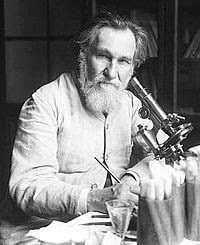
Ilya Ilyich Mechnikov
1845-1916

Mechnikov received the Nobel Prize in Medicine in 1908, shared with Paul Ehrlich, for his work on phagocytosis. 

He is also credited by some sources with coining the term gerontology in 1903, for the emerging study of aging and longevity.

Mechnikov also developed a theory that aging is caused by toxic bacteria in the gut and that lactic acid could prolong life. 

Based on this theory, he drank sour milk every day. 

Mechnikov wrote three books: Immunity in Infectious Diseases, The Nature of Man, and The Prolongation of Life: Optimistic Studies, the last of which, along with his studies into the potential life-lengthening properties of lactic acid bacteria (Lactobacillus delbrueckii subsp. bulgaricus), inspired Japanese scientist Minoru Shirota to begin investigating the causal relationship between bacteria and good intestinal health, which eventually led to the worldwide marketing of kefir and other fermented milk drinks, or probiotics.

Probiotics are live bacteria that may confer a health benefit on the host.

Kefir is a natural probiotic and there is evidence to suggest that probiotic bacteria in the gut of kefir consumers are abundant and diverse.

Even today, many years after Mechnikov and Shirota began their studies, scientists continue to investigate the importance of the gut microflora for human health.

A number of strains of kefir bacteria exhibit high levels of acid and bile tolerance and can survive transit through the stomach and the upper gastrointestinal tract. These may therefore be valuable as probiotic cultures in the production of fermented foods.

Kefir is loaded with valuable enzymes, easily digestible sugars, beneficial acids, vitamins and minerals. 

Water kefir supplies your body with billions of healthy bacteria and yeast strains. Some store-bought probiotic foods or supplements can help, but they are not as potent, and do not usually contain the beneficial yeasts, just bacteria. 

Within your body there are already billions of bacteria and yeast. Your internal microflora support proper digestion, synthesis of vitamins and minerals, and your immune system by warding off foreign and harmful bacteria, yeast and viruses. Kefir has thus long been known to promote and aid in digestion and overall health.  


A study on the effects of kefiran in animals demonstrated that kefiran significantly suppressed increase of blood pressure and reduced the serum cholesterol levels in rats when subjects consumed excessive dietary cholesterol. 

Kefiran supplementation also significantly lowered blood glucose in experimental mice. 

In addition, the administration of kefiran in constipated rats caused an obvious improvement in the levels of faecal moisture and wet weights of faeces.

There is therefore interest in the potential use of kefir as a functional food to prevent some commonly occurring health conditions.

How to make water kefir


Ingredients

  • 1 tablespoon of water kefir grains - you can order these on the internet from various companies
  • 1 tablespoon raw sugar, agave nectar, or maple syrup (honey will work but it is antibacterial and will slowly kill the grains, so this is not a good idea). Water kefir grains grow better in a high-mineral environment. Using high mineral sweeteners such as raw sugar, or adding a bit of molasses to your brew will help your grains grow faster.
  • 1 slice of lemon. The lemon serves as a natural pH buffer, lowering the pH to protect the water kefir from foreign and competing contaminants. Lemon peel also is high in calcium, a main mineral for the grains. 
  • Small handful or raisins or 2-3 dried apricots. The dried fruit serve as an added source of sugar and the various minerals found within them (including a good dosage of potassium and magnesium). It is interesting that just as for us, it is important for kefir grains to receive a large amount of calcium, potassium and magnesium (and other trace minerals). Some dried fruits seem to work better than others. Raisins are the traditional fruit of the recipe, but dates, figs, apples, apricots and coconut among others also work very well.
  • 1 cup filtered or spring water

To make larger quantities, simply scale up the ingredients.

Method

  1. Mix all ingredients in a kilner jar, adjusting quantities to fit the size of the jar you have chosen
  2. Screw on the lid and leave at room temperature for 24 to 48 hours 
  3. Strain and decant the water kefir into a bottle
  4. Rinse the grains, put them back in the jar with the same combination of ingredients and repeat. This can go on indefinitely. 
  5. With the strained kefir you can bottle it and let it 'ripen' out on the counter for another day or two, store it in the fridge, or drink it there and then


Please note that water kefir contains about 0.038% - 2% alcohol, or 16-38 g/L (grams per litre), with the normal amount being around .08% or less for a 48-hour ferment. 

Kefir that is stored and ripened for a few days will continue to increase in alcohol, up to 2-3% (when it is sealed tightly). 

For reference, beer contains about 4-7% and wine 8-14%. Because kefir contains bacteria (and not just yeast like beer or wine) the amount of alcohol kefir can produce is limited by the acetic bacteria which convert the alcohol (produced by the yeasts) to beneficial acids.


Lime; lychee; pineapple and ginger water kefir drinks fermenting
www.cookingforhealth.biz

Variations


You can add fruit and other ingredients to flavour your water kefir, such as:

Slices of fresh root ginger
Slices of lime
Dried fruit such as figs
Fresh fruit
Fruit juice
Coconut water
Nut or grain milks

It's possible to ferment some fruit juices, sugar-based vegetable juices (like beet, carrot or ginger) coconut juice, and possibly other sugar based juices you may find at the store (like orange juice or fruit punch) and sometimes milk (including all forms of mammalian milk: mare, goat, sheep, cow, buffalo, camel etc) or milk alternatives like soy, almond or rice. 

Since water kefir grains are sensitive, its always best to feed your main grains with the normal recipe, and use your extra grains to experiment with in new liquids. 

I have found the grains do not thrive with oranges, pineapples or berries. They loved lychees though - just like me :)

Their growth also seems to slow down when incubated with raw ginger for too long, so I return the grains to an ordinary sugar-lemon mixture after brewing ginger 'beer'.

Here are some delicious recipes I have tried:

Ginger beer


Ingredients
  • 1 tablespoon water kefir grains
  • 1-2 tablespoon raw sugar
  • 1-2 cups water
  • 4 slices fresh root ginger

Method
  1. Mix ingredients together, screw on lid and leave for 24-48 hours
  2. Strain and bottle the liquid
  3. Rinse the grains and repeat with the same ingredients


Lychee Soda


Ingredients
  • 1 tablespoon water kefir grains
  • 1 can lychees in juice
  • Filtered or spring water to top up if required

Method
  1. Mix ingredients together, screw on lid and leave for 24-48 hours
  2. Strain and bottle the liquid
  3. Rinse the grains and repeat with the same ingredients


Pineapple and ginger


Ingredients
  • 1 tablespoon water kefir grains
  • 1 tablespoon raw sugar
  • Small handful of raisins
  • 2 slices pineapple (chopped)
  • 3 slices fresh root ginger
  • Filtered or spring water to top up if required

Method

  1. Mix ingredients together, screw on lid and leave for 24-48 hours
  2. Strain and bottle the liquid
  3. Rinse the grains and repeat with the same ingredients if required

This tasted wonderful but the kefir grains weren't too happy after several rounds of this, so I think it is best to return the grains to the regular sugar-lemon mixture straight after finishing this.

For further information and answers to frequently asked questions about water kefir please click here.


If you have enjoyed this post, please sign up for my newsletter to keep informed of new information, recipes and courses and visit my website.

You can also join me on Facebook, Twitter, Pinterest and LinkedIn.