Showing posts with label carrot. Show all posts

Friday, January 16, 2015

How to make vegetable sushi nori


When I was a PhD student, I was fortunate to be awarded a scholarship for a study trip to Japan. 

There, I visited all the key University labs and Research Institutes working in my field of research.

Beforehand, I'd bought a Railcard and had planned to stay in Youth Hostels over the country. 

Due to the extraordinary hospitality of my academic contacts, however, I ended up staying with different Japanese families for the entire time, which was a real privilege.

I'll never forget one evening in the home of a Professor at the University of Okayama. His wife and three young children all sat round the kitchen table making sushi rolls, which we later ate for supper.

The children were so excited to meet an English person and thrilled to show me their food and customs. It was magic.

In Japan, making sushi is considered a vocation, an art form, and chefs, or itamae, train with almost military rigour for anything from 2 to 20 years to become proficient.

Traditionally, raw fish is used in sushi and cutting it up in the correct way appears to be akin to learning to perform brain surgery.

Even the preparation of rice is a precise procedure. Too much rice and it will be more than a mouthful; too little and it will be overpowered by the fish; too much pressure and it will be hard; too little and the pellet will fall apart.

Most of us don't aspire to the heights of becoming a senior sushi chef, so we can relax and enjoy creating simple vegetable sushi rolls, which are great for lunchboxes, snacks, picnics and parties. 

This recipe for sushi rolls uses the sea vegetable known in Japanese as nori (Porphyra spp).

Nori is the most popular of all sea vegetables as it's versatile and easy to prepare. It has a sweet and salty taste. 

Nori contains more protein than other sea vegetables, averaging a remarkable 40% by weight.  It contains about 1.5 times more vitamin C than oranges and as much vitamin A as carrots.  Nori is the only sea vegetable reported to contain the biologically active form of vitamin B12. The mineral content of nori is about 10% by weight, which is lower than other sea vegetables, but is still very high for a vegetable food.  

Sea vegetables have numerous health benefits and are valuable for boosting mineral intake in your diet.

Nori is sold either as flakes or as sheets, which are folded 7 or 10 to a pack.  

The flakes don't require soaking or cooking and can be sprinkled directly onto grains, or incorporated into purées, batters, sauces, dressings and dips to give an appealing herb-like flavour.  

Nori sheets are best lightly toasted before use.  This is done by rotating the sheet, shiny side up, over a low flame for a few seconds until its colour changes to a lighter green.  Pre-toasted nori sheets are also available in the shops.  Once toasted, nori can simply be torn into smaller pieces or cut with scissors into attractive shapes.  These pieces can be added as a garnish to cereal dishes, soups and salads or mixed with nuts and seeds to make a tasty snack.  Toasted sheets of nori can also be used to make sushi rolls and rice balls.

Ingredients

Makes 2 sushi rolls, at least 3 servings

  • 2 sheets nori sea vegetable, toasted
  • 1 cup short-grain brown rice
  • 2 cups boiling water
  • 1 tbsp brown rice vinegar
  • 1 tbsp rice malt syrup
  • 1 tsp peanut butter
  • ½ tsp umeboshi plum paste (available online or in health food stores)
  • 1 carrot (100g/4oz), finely sliced
  • 1/3 raw cucumber (100g/4oz), finely sliced
  • ¼ red pepper (30g), finely sliced
  • 50g/2oz marinated tofu, finely sliced
  • Few pieces of sushi ginger or 1 tsp mustard 


Method


Add 1 cup short-grain rice and 2 cups boiling water to a thick-based pan, cover with a lid and bring to a boil. 

Turn down to a very low heat and simmer for 40-45 minutes until water has evaporated and rice is soft. 

Mix brown rice vinegar and rice malt syrup together and stir into rice. 

Allow to cool. You need to use short-grain rice as this sticks together, unlike long grain or basmati rice.


You can buy nori sheets already toasted. 


If you have untoasted nori, simply hold the rough side of each sheet over a low flame for a few seconds until colour changes to a lighter green. 


Cut the carrot and cucumber into fine strips. I cut the vegetables thinly on the diagonal and then slice the pieces into narrow strips.


Having prepared all the fillings, lay one sheet of toasted nori, shiny side down, on a bamboo sushi mat, with the stripping of the map running horizontally.


Spread 1 cup  cooked rice evenly over the nori, leaving 1/3 inch (1cm) at the bottom, nearest you, and 1 ½ inches (4 cm) at the top, firmly pressing the rice into the nori


Gently spread nut butter, umeboshi paste, carrots, cucumber, pepper, tofu and sushi ginger horizontally in a strip across the rice.

If you add too much filling, you'll find it difficult to roll the sushi up.


Pick up the edge of the bamboo sushi mat and carefully roll it away from you around the ingredients, into a cylindrical roll. 

Using your finger or a pastry brush, spread a little water on the exposed top edge of the nori to help the roll stick together.


You should end up with a cylindrical roll as in the photograph below.


Using a sharp knife dipped into water, cut the sushi nori roll into slices and serve garnished with chopped vegetables and salad.

You can create many variations with different fillings and flavours, just like sandwiches.  

For example, you can include avocado with lime juice; spring onions (scallions); bean sprouts; roasted sweet potato or squash; sesame seeds; toasted walnuts; shiitake mushrooms sautéed in soy sauce; mustard; wasabi; regular mustard; steamed broccoli pieces or asparagus.


~

If you've enjoyed this post and would like to keep in touch please sign up for my free email newsletter and get a free report on calcium and your health.

You can also visit my website and follow me on Facebook, Twitter, Pinterest and LinkedIn.

~

Nutrition information


Saturday, August 10, 2013

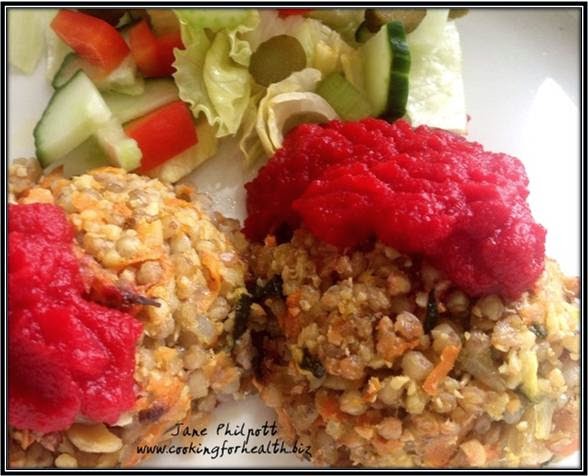
Buckwheat, sweet potato, courgette and cashew croquettes with roasted beetroot and onion sauce


Here is a gluten-free plant-based recipe for some savoury croquettes. These are versatile and easy to make. They can be served as a grain dish alongside other dishes as part of a main meal or eaten on their own with a green salad for a light lunch.


You may be thinking "what on earth is buckwheat?"

Despite its name, buckwheat is not botanically related to wheat at all.

This is excellent news if you are on a gluten-free diet.

Buckwheat is a broad-leaf plant, not a grass like wheat.

The term 'buckwheat' refers to plants in two genera of the family Polygonaceae: the Eurasian genus Fagopyrum, and the North American genus Eriogonum. Rhubarb is also a member of this plant family.

The crop plant, common buckwheat, is Fagopyrum esculentum.

Tartary buckwheat (F. tataricum Gaertn.) or "bitter buckwheat" is also used as a crop, but is much less common.


Buckwheat (Fagopyrum esculentum)

Common buckwheat was domesticated and first cultivated in southeast Asia, possibly around 6000 BC, and from there spread to Europe and to Central Asia and Tibet.  It was cultivated in Europe in the Balkans around 4000 BC.

In Central and Eastern Europe, kasha - cooked buckwheat - is eaten as porridge, used in pilav or for stuffing traditional Jewish snacks called knish.


Buckwheat grain

Buckwheat is either eaten whole or ground into flour to be used in breads, pancakes or thin noodles (soba).

It can be purchased raw to be lightly dry-roasted at home before cooking and generally combines well with vegetables.

In recent years, buckwheat has been used as a substitute for other grain in gluten free beer.

Nutrients and health benefits of buckwheat


Buckwheat contains about 75% carbohydrate, 18% protein and is rich in iron, zinc and selenium.

Its protein contains all of the essential amino acids except lysine, so its protein value is over 90%.

It also contains significant quantities of anti-oxidants.

One of these is called rutin, a phytochemical with interesting biological activities.

Conventionally, rutin is used as an antimicrobial, antifungal, and antiallergic agent. However, current research suggests potential benefits for the treatment of various chronic diseases such as cancer, diabetes, hypertension and hypercholesterolemia.

Rutin is said to strengthen capillary walls, reducing haemorrhaging in people with high blood pressure; reduce blood pressure; lower blood lipids; prevent damage from alcohol-induced inflammation in the liver; and increase circulation to the hands and feet.


RECIPE

Makes about 10 croquettes

Ingredients


Croquettes

1 cup buckwheat grain (washed)
2 cups boiling water from kettle
1/2 medium onion (finely chopped)
1/2 small sweet potato (grated)
1/4 medium courgette (zucchini), grated
1 small handful cashews (finely chopped)
1/2 strip wakame sea vegetable (soaked for 10 minutes and finely chopped) 

Sauce

4 small beetroot or 2 medium beetroot (washed and scrubbed)
2 medium carrots (peeled)
1 medium onion (unpeeled)
1/2 cup water
2 tsp white miso

Instructions


Sauce

  1. Pre-heat oven to 190 C, wrap beetroot, carrot and whole onion in foil and bake for 45 minutes or until vegetables are soft.
  2. While vegetables are cooking, prepare the croquettes as shown below.
  3. Allow beetroot, carrots and onion to cool, remove skins from cooked beetroot and onion. Cut cooked beetroot, carrot and onion into pieces, put all in a food processor and blend until smooth. Add water to achieve the desired consistency for a sauce. Add ume seasoning, apple juice concentrate and white miso to taste.

Croquettes

  1. Place buckwheat in a thick pan, add hot water, put the lid on and bring to the boil. When boiling, turn heat down low and simmer with the lid on for 20-30 minutes, until the buckwheat is soft and cooked. There should be no water left in the pan.
  2. While the buckwheat is cooking, saute the onion, grated sweet potato, grated courgette (zucchini) and spices until vegetables are soft and the onion translucent. Add chopped cashews and wakame.
  3. Mix vegetables with buckwheat, mould into round balls and flatten gently. If you use too many vegetables in proportion to buckwheat, the mixture will become too moist and the croquettes won't stick together. 
  4. Place on a greased baking tray and bake in a pre-heated oven at 180 C/gas mark 4 for 20 minutes or until croquettes are golden brown.
  5. Serve with beetroot and onion sauce and a salad garnish.


Variations


Like rice and other grains, buckwheat provides a neutral base to which almost any combination of seasonal vegetables, vegetarian proteins, herbs and spices can be added. 

You can also use a variation of this recipe to make buckwheat pilav. Use 1/2 cup buckwheat cooked in 1 cup water to the same quantity of vegetables listed above. Instead of forming into patties, just mix grain and vegetables together and serve with a garnish.


Buckwheat pilav


If you have enjoyed this post, please sign up for my newsletter to keep informed of new information, recipes and courses and visit my website.

You can also join me on Facebook, Twitter, Pinterest and LinkedIn.


Saturday, April 27, 2013

Herby lemon chickpea falafels


Falafel is a traditional Arab food, usually served in pitta bread with fresh salad, pickled vegetables and tahini-based sauces.  They can be eaten on their own as a snack or served as part of a meze, which is a mixture of different starters.  They are usually deep-fried but I prefer to brush them with olive oil and bake them in the oven.

Traditionally, falafel are made with chickpeas or fava beans.

According to The Encyclopedia of Jewish Food by Gil Marks,

“The first known appearance of legume fritters (aka falafel) in the Middle East appears to be in Egypt, where they were made from dried white fava beans (ful nabed) and called tamiya/ta-amia (from the Arabic for ‘nourishment’); these fritters were a light green colour inside. Many attribute tamiya to the Copts of Egypt, who practiced one of the earliest forms of Christianity. They believed that the original state of humankind was vegetarian and, therefore, mandated numerous days of eating only vegan food, including tamiya.”

Traditionally, spices and herbs such as ground cumin, ground coriander and parsley are used in falafel but you can add all sorts of different vegetables, herbs and spices to change the flavour.  Here are some ideas:

  • Roasted red pepper and fresh basil
  • Fennel seeds, carrot and orange zest
  • Butternut squash and sumac
  • Lemon and fresh coriander

You just need to take care to achieve the right balance between the quantity of chickpeas and the quantity of fresh herbs and vegetables, otherwise the mixture will go mushy and you will not be able to form it into balls.  If your mixture is too mushy you can try reducing the quantity of vegetables used, increasing the quantity of chickpeas and/or adding some chickpea (gram) flour to help to bind it.

Please let me know how you get on if you try this recipe as I am always striving to improve how I explain things.  I'd also like to know what you think of the recipe format, so please leave your comments below.

If you have enjoyed this post and would like to keep in touch please sign up for my free email newsletter.

You can also follow me on Facebook, Twitter, Pinterest and LinkedIn and visit my website.


Recipe

Serves 4

Ingredients
Method

1 small white onion, finely chopped

1 tablespoon olive oil

1 pinch sea salt

Saute chopped onion in olive oil with a small pinch of salt (the salt draws water out of the onion and lowers the temperature, so prevents burning) on a low flame until soft and translucent.  If the oil sizzles the temperature is too high.

1 small carrot, grated
Add the carrot to the onion and sauté gently

1 can cooked chickpeas, drained and rinsed

1 small handful fresh green herbs, e,g, one or more of parsley, thyme, lemon balm, marjoram, coriander

Zest of ½ lemon

1 dessertspoon sweet white miso (shiro miso).  You can just use salt and pepper if you have no miso though you will miss out on all the amazing nutrients in this fermented soy paste.

Fresh parsley or coriander to garnish
Put chickpeas, herbs, lemon zest and miso into a blender jug and add the sauted onion and carrot.

Blend until smooth.

Taste and adjust seasoning as appropriate

Shape into small balls about the size of a ping-pong ball, slightly flatten, place on a parchment-lined baking tray and brush with a little olive oil.

Bake in a medium oven (180˚C, 350˚F, gas mark 4) for 20-25 minutes or until lightly brown.

Garnish with parsley or coriander and serve as a sandwich in pitta bread with salad, on their own as a snack or as one of a selection of starters (meze).

Tuesday, February 19, 2013

Beetroot, carrot, apple and ginger juice


Here is a strengthening juice to tickle your tastebuds and ward off colds, tummy bugs and hangovers.

It is rich in nutrients and phytonutrients, with antioxidant, anti-inflammatory, anti-hypertensive and anti-bacterial properties.

Ingredients
1 fresh beet, with root and greens
2 carrots
1 apple
1 piece fresh root ginger (2-4 cm)

Instructions
Process all ingredients in a vegetable juicer and drink.  Super easy.


Health benefits

Beets
Beet greens are even higher in nutritional value than beetroots, as they are richer in calcium, iron, and vitamins A and C.  Beetroots are an excellent source of folic acid and a very good source of fibre, manganese and potassium.  Both beet greens and roots are a good source of magnesium, phosphorus, iron and vitamin B6.

Beetroots have long been used for medicinal purposes, particularly as they are known to stimulate the liver's detoxification processes.  The pigment that  gives beets their deep purple colour is called betacyanin and is a powerful anti-cancer agent.

Beetroot may also protect against heart disease as it has been shown to dilate blood vessels and lower diastolic blood pressure.

Carrots
Carrots provide the highest source of vitamin A carotenes of commonly consumed vegetables.  Two carrots provide roughly four times the daily reference nutrient intake of vitamin A.  Carrots also provide excellent levels of vitamin K, biotin and fibre and very good levels of vitamins C, B1 and B6, and potassium.  The antioxidant content of carrots helps to protect against chronic diseases like heart disease and cancer.  Carrots also promote good vision and along with other fruit and vegetables help to protect against macular degeneration.

Apples
Apples are a good source of vitamin C, pectin and other fibres, and potassium.  Most of the apple's important nutrients are contained in its skin.  If apples are raw and unpeeled, they are also a great source of many phytonutrients, such as ellagic acid and flavonoids such as quercetin.  The old saying "an apple a day keeps the doctor away" has a great deal of truth in it.  In a review of various studies, apple consumption was shown consistently to be associated with a reduced risk of heart disease, cancer, asthma and type 2 diabetes, compared with other fruits and vegetables.


Root ginger
Ginger contains small quantities of vitamins such as B6 and B5, as well as minerals such as potassium, manganese, copper, and magnesium.  It has been used since ancient times for its anti-inflammatory, antioxidant, carminative, anti-flatulent, and anti-microbial properties. The root contains essential oils such as gingerol, zingerone, shogaol, farnesene, and small amounts of β-phelladrene, cineol, and citral.   Gingerols help improve intestinal motility and have anti-inflammatory, painkiller (analgesic), nerve soothing, anti-pyretic as well as anti-bacterial properties. Studies have shown that ginger may reduce nausea induced by chemotherapy, motion sickness or pregnancy and may help relieve migraine headache.  Zingerone, a chemical compound which gives pungent character to the ginger root, is effective against E.coli induced diarrhoea, especially in children.

You can find more free articles and resources on my website and receive further information and news by signing up for my free newsletter.

You can also find me on Facebook, Twitter, Pinterest and LinkedIn.